O-1A High Salary Criterion: How to Establish That Your Compensation Is High Relative to Others.
Learn how to demonstrate high salary or other remuneration for an O-1A visa petition. Explore compensation benchmarks, industry comparisons, salary evidence, supporting documentation, and strategies to establish that your compensation is high relative to others in your field.


For professionals with exceptional skills in science, business, education, or athletics, the O-1A visa can open the door to exciting career opportunities in the United States. However, preparing a strong petition requires more than demonstrating professional experience or receiving an attractive job offer. Applicants must provide convincing evidence that supports their eligibility under the applicable immigration criteria.
One important consideration is the high salary criterion. If you earn significantly more than other professionals in your field, your compensation may help demonstrate your professional standing. But how can you establish that your salary is genuinely high compared with others doing similar work?
Understanding how to prove high salary for O1A visa USCIS requires careful documentation, reliable salary comparisons, and a clear explanation of why your compensation stands out.
In this guide, we explain the O-1A high salary criterion, the evidence you can submit, and the common mistakes to avoid when preparing your petition.
What Is the O-1A High Salary Criterion?
The O-1A visa is a nonimmigrant visa category for individuals who demonstrate extraordinary ability in the sciences, education, business, or athletics.
Under the applicable regulations, one of the evidentiary criteria allows applicants to demonstrate that they have commanded, or will command, a high salary or other significantly high remuneration compared with others in their field.
In simple terms, earning a high salary is not enough by itself. You must demonstrate that your compensation is high relative to professionals working in comparable occupations.
For example, a senior technology executive earning substantially more than professionals in similar positions may be able to use that compensation as supporting evidence. However, the strength of the evidence depends on the individual's actual earnings, the reliability of the comparison data, and how closely the comparison matches their occupation.
The O1A visa high salary criterion is one of the evidentiary criteria available to eligible applicants. Meeting it does not automatically guarantee visa approval, as USCIS evaluates the petition under the applicable eligibility requirements.
How to Prove High Salary for O1A Visa USCIS
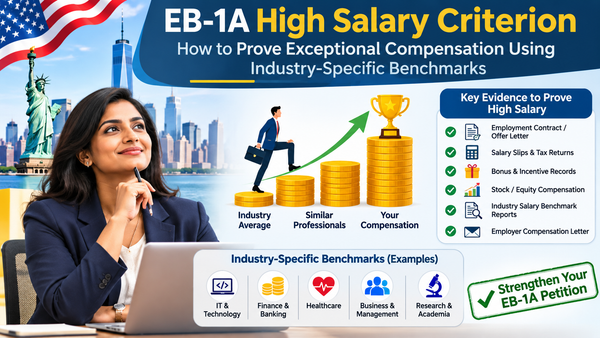
The most effective approach is to present evidence that connects three important elements: your actual or prospective compensation, reliable salary benchmarks, and your position relative to other professionals in your field.
Here are the main steps to consider.
1. Provide Reliable Evidence of Your Salary
Start by documenting how much you currently earn or have earned for your professional services.
Useful documents may include:
· Recent payslips showing your salary and compensation.
· Tax returns or official tax statements.
· Employment verification letters confirming your compensation.
· Employment agreements specifying your salary.
· Bonus statements or records of performance-based compensation, where relevant.
· Contracts or credible job offers documenting prospective compensation.
If you are self-employed or work as a consultant, invoices, client contracts, payment records, and financial documents may help establish your remuneration.
Make sure the documents are consistent. If your employment contract lists one salary but your payslips show another amount, explain the difference clearly.
USCIS may also consider credible evidence of future compensation. Therefore, applicants do not necessarily need to rely exclusively on salary already earned.
2. Compare Your Compensation With Industry Standards
Your salary documents establish what you earn, but they do not necessarily prove that your compensation is unusually high.
To address this, compare your earnings with those of professionals performing similar work.
Reliable sources may include:
· The U.S. Bureau of Labor Statistics (BLS).
· The U.S. Department of Labor's CareerOneStop resources.
· Reputable industry compensation surveys.
· Position-specific salary reports.
· Credible professional compensation studies.
· Occupational Employment and Wage Statistics (OEWS).
· The Foreign Labor Certification Data Center (FLCDC) Online Wage Library.
For instance, consider a Senior Machine Learning Engineer based in San Francisco earning a base salary of $300,000 plus equity. To satisfy the criterion, counsel would pull the BLS OEWS data for 'Computer and Information Research Scientists' in the San Francisco-Oakland-Hayward metro area, demonstrating that the applicant's compensation sits comfortably above the 90th percentile benchmark.
If the report is reliable and the comparison is appropriate, it may help demonstrate that the individual's compensation is unusually high.
However, the numbers must come from genuine sources. Avoid selecting salary statistics simply because they support your case.
3. Choose the Right Salary Benchmark
Selecting an appropriate benchmark is one of the most important parts of establishing a credible O1A high remuneration benchmark
A comparison becomes less persuasive when it combines professionals with substantially different responsibilities, experience levels, or occupations.
For instance, comparing a chief technology officer's compensation with the average salary of all technology workers may not provide a meaningful picture.
Instead, look for data that reflects:
· Your specific occupation or professional specialization.
· Your seniority and level of responsibility.
· Your relevant geographic location.
· The industry in which you work.
· The compensation period covered by the report.
Location is particularly important. under USCIS policy, if an applicant earned their salary outside the U.S., immigration officers evaluate it using wage statistics relevant to that specific foreign country's market location, rather than blindly converting the local currency directly into U.S. dollars.
A well-matched salary comparison is generally more useful than a collection of unrelated salary figures.
4. Document Bonuses and Other Forms of Remuneration
Base salary is not always the full picture of professional compensation. Depending on your field-especially in tech or executive leadership-a significant portion of your total remuneration may come from performance bonuses, commissions, equity grants, or profit-sharing. If you receive these benefits, document them carefully to present a complete financial profile to USCIS:
· Stock Options & Equity (RSUs): Vested Restricted Stock Units (RSUs), stock options, or company equity can count toward establishing "significantly high remuneration." However, USCIS generally requires concrete proof of value. Avoid relying on speculative or unvested equity projections. Instead, provide independent third-party valuation reports (such as 409A valuations for early-stage startups), official capitalization tables, stock purchase agreements, or tax documents (e.g., Form W-2 showing vested shares) that demonstrate realized monetary value.
· Performance Bonuses & Incentives: An executive or researcher's package might include a base salary paired with guaranteed or milestone-based performance bonuses. Relevant employment agreements, official board resolutions, and bank deposit records can help establish the exact value and nature of that compensation.
For example, an executive's compensation package might include a base salary, an annual performance bonus, and a contractual incentive payment. Relevant agreements and payment records can help establish the value and nature of that compensation.
Distinguish between compensation that has actually been received and benefits that are merely anticipated. If you rely on prospective remuneration, provide credible documentation explaining the terms.
The goal is to give USCIS a clear and supportable picture of your compensation rather than relying on an unsupported estimate of your total earnings.
5. Explain Why Your Compensation Is Significant
Numbers become more meaningful when the petition explains what they demonstrate.
An employer letter may help explain why the organization pays you above typical market rates. For example, the employer might describe your specialized expertise, leadership responsibilities, or the unusual value you bring to a particular project.
Such explanations should be specific and supported by relevant documentation.
An employer's statement that you are a highly valued employee may be helpful, but a general compliment is unlikely to be as persuasive as a detailed explanation supported by compensation records and reliable market data.
Your evidence should tell a consistent story: what you earn, what comparable professionals earn, and why the comparison is appropriate.
What Is O-1 Visa Compensation Evidence?
Strong O1 visa compensation evidence combines proof of earnings with credible information about the broader market.
A practical evidence package may contain:
1. Payslips, tax documents, or other records of past remuneration.
2. An employment agreement or job offer establishing prospective compensation, where applicable.
3. Independent salary surveys relevant to your occupation and location.
4. A clear comparison between your compensation and the selected benchmark.
5. An employer letter explaining above-market compensation, when appropriate.
6. Supporting records for bonuses, commissions, or other remuneration included in the calculation.
Not every applicant needs every document listed above. The appropriate evidence depends on the individual's circumstances and the nature of the compensation being claimed.
The key is to make the evidence easy to understand and independently assess.
Common Mistakes to Avoid When Proving High Salary
Even a well-paid professional can face difficulties establishing this criterion if the supporting evidence is weak or incomplete.
Watch out for these common mistakes:
Using unrelated salary data: Comparing your earnings with professionals in different occupations or industries may weaken your argument.
Relying only on a high salary figure: A large annual salary does not automatically demonstrate that your compensation is high relative to comparable professionals.
Submitting unreliable salary surveys: Anonymous websites or reports based on limited, unclear data may not provide a convincing benchmark.
Ignoring location differences: Salary comparisons should reflect the relevant geographic market, especially when your employment is outside the United States.
Overlooking prospective compensation: If you rely on a job offer, make sure the contract clearly identifies the compensation and provides credible evidence of the proposed employment arrangement.
Failing to explain the comparison: Simply submitting payslips and salary surveys may leave important questions unanswered. Explain how the figures relate to your occupation and why the selected comparison is appropriate.
Does Meeting the High Salary Criterion Guarantee O-1A Approval?
No. The high salary criterion is only one of the evidentiary criteria available for an O-1A petition.
Generally, applicants must demonstrate a qualifying internationally recognized award or satisfy at least three of the eight regulatory evidentiary criteria, subject to the applicable requirements and overall assessment of the petition.
USCIS also evaluates the evidence as a whole when determining whether the individual has extraordinary ability and meets the requirements for O-1A classification.
Therefore, strong compensation evidence should form part of a broader petition strategy rather than serve as the only basis for claiming extraordinary ability.
Final Thoughts
Establishing high remuneration for an O-1A petition is not simply about earning a large salary. It is about demonstrating, with credible documents and relevant comparisons, that your compensation stands out among professionals performing similar work.
If you are researching how to prove high salary for O1A visa USCIS, start by collecting your salary records, identifying reliable compensation benchmarks, and ensuring that the comparison reflects your occupation, experience level, and location.
A carefully prepared evidence package can make it easier for USCIS to understand your compensation and evaluate the claim under the applicable criterion.
Every petition is different, so consider consulting a qualified U.S. immigration attorney to assess your circumstances and determine how best to present your evidence.
Disclaimer: This article provides general information about U.S. immigration requirements and is not legal advice. Eligibility and petition outcomes depend on the individual facts and applicable law.