EB-1A RFE Received: How to Respond to USCIS and Strengthen Your Extraordinary Ability Green Card Petition
Receiving an EB-1A Request for Evidence (RFE) from USCIS does not necessarily mean your green card petition will be denied. Learn how to understand the RFE notice, address evidentiary gaps, strengthen your extraordinary ability criteria, and prepare a well-supported response before the deadline.

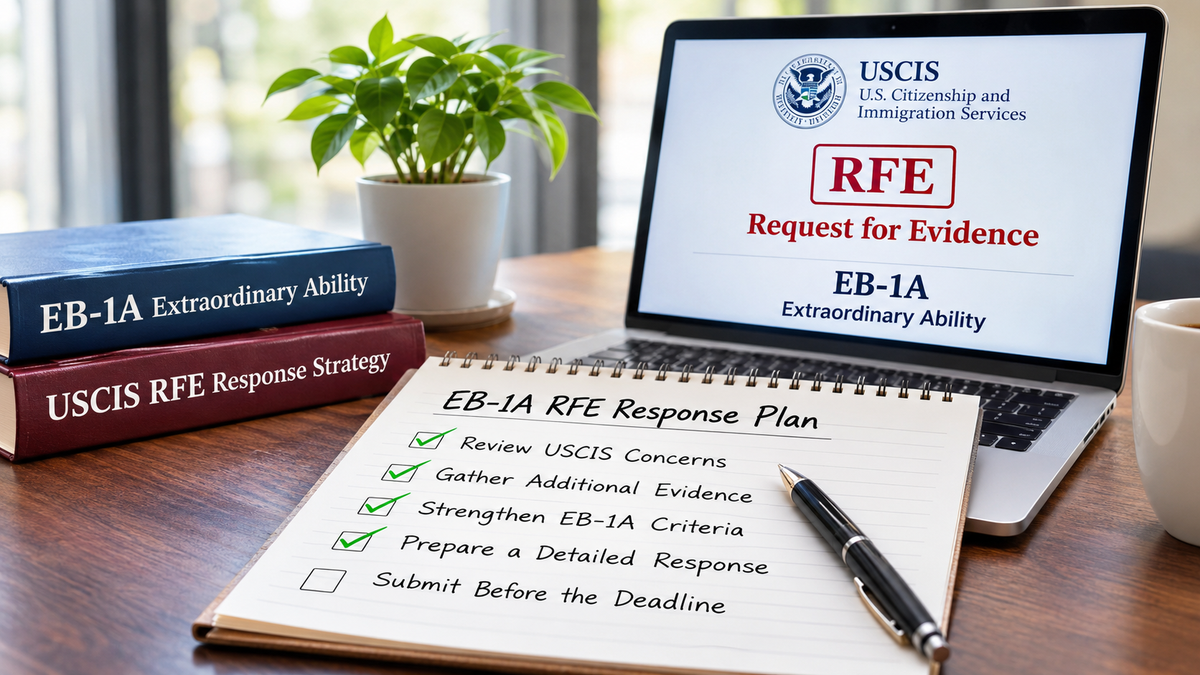
Receiving a Request for Evidence (RFE) from U.S. Citizenship and Immigration Services (USCIS) can be stressful, especially when you have invested considerable time and effort in preparing your EB-1A extraordinary ability green card petition. However, an RFE does not automatically mean your petition will be denied. It means USCIS needs additional information, clarification, or stronger supporting evidence before making a final decision.
For professionals, researchers, entrepreneurs, executives, scientists, and other individuals seeking an EB-1A green card, responding to an RFE is an important opportunity to address the concerns raised by the immigration officer. A carefully prepared response can help establish that your achievements meet the legal requirements for extraordinary ability.
Understanding how to respond to EB1A RFE extraordinary ability cases requires more than submitting additional documents. It involves identifying the officer's concerns, presenting relevant evidence, explaining the significance of your accomplishments, and connecting every supporting document to the applicable EB-1A eligibility criteria.
This guide explains how to approach an EB-1A RFE, develop an effective response strategy, and strengthen your extraordinary ability petition.
1. What Does an EB-1A Request for Evidence Mean?
An EB-1A RFE is an official notice requesting additional documentation or explanations to determine whether an applicant qualifies for an employment-based first-preference immigrant visa as an individual of extraordinary ability.
Receiving an extraordinary ability green card RFE can be concerning, particularly for applicants who have already submitted extensive documentation of their professional achievements. However, an RFE provides an opportunity to clarify eligibility, address USCIS concerns, and present stronger supporting evidence. Understanding the specific reasons behind the request is essential to preparing a focused response that demonstrates your extraordinary ability and professional recognition.
Under the EB-1A category, applicants must demonstrate extraordinary ability in their field through sustained national or international acclaim. They must generally provide evidence of a major, internationally recognized award or satisfy at least three of the ten regulatory evidentiary criteria, followed by an overall assessment of their achievements.
USCIS may issue an RFE when the officer believes that:
- The submitted evidence does not sufficiently establish one or more EB-1A criteria.
- Recommendation letters lack specific examples or independent verification.
- Published material does not demonstrate the applicant's recognition in the industry.
- Research citations or original contributions lack evidence of significant impact.
- The applicant's leading or critical role is not adequately established.
- The evidence does not demonstrate sustained national or international acclaim.
- The overall record does not establish that the applicant belongs to the small percentage at the top of their field.
An RFE should not be treated as a rejection. Instead, applicants should view it as an opportunity to address specific weaknesses in the existing petition.
2. Understand the USCIS Concerns Before Preparing Your Response
The first step in developing an effective EB1A RFE response strategy is carefully reviewing the entire RFE notice.
Avoid immediately collecting random documents or requesting additional recommendation letters. Instead, identify exactly what the immigration officer is questioning.
For example, if USCIS questions your original contributions of major significance, simply submitting another certificate or employment letter may not resolve the concern.
You need to demonstrate:
- What original contribution you made.
- How your contribution differs from existing work in the field.
- Why the contribution is important.
- Whether other professionals or organizations have relied on your work.
- How the contribution has influenced the broader industry.
Similarly, if USCIS questions your critical role, provide evidence showing how your responsibilities influenced important organizational decisions, projects, business outcomes, or institutional success.
A successful response addresses the officer's actual concerns rather than simply repeating the arguments from the original petition.
3. Build a Strong EB1A RFE Response With Criterion-Specific Evidence
Every EB-1A criterion requires evidence that establishes the relevant regulatory requirements. Your response should therefore be organized around the specific criteria challenged in the RFE.
A. Original Contributions of Major Significance
If USCIS questions the significance of your original contributions, provide evidence demonstrating their influence beyond your immediate responsibilities.
Useful supporting documents may include:
- Independent expert recommendation letters.
- Research papers and citation records.
- Evidence of industry adoption.
- Patents and licensing documentation.
- Media coverage discussing your contributions.
- Records demonstrating measurable improvements or commercial impact.
For example, a software engineer who developed an innovative technology solution should explain how the solution improved operational efficiency, influenced other organizations, or contributed to technological advancement.
The objective is to establish not only that the applicant created something original but also that the contribution was significant in the field.
B. Leading or Critical Role
Applicants working at Fortune 500 companies, multinational corporations, universities, or recognized institutions may receive questions about their individual contributions.
USCIS may want to understand whether the applicant personally performed a leading or critical role rather than simply working for a prestigious organization.
To strengthen this criterion, submit:
- Employment verification letters describing specific responsibilities.
- Organizational charts showing reporting relationships.
- Performance evaluations.
- Project leadership documentation.
- Evidence of important business decisions.
- Records showing measurable organizational achievements.
Remember, the reputation of an employer alone does not establish eligibility. The evidence must demonstrate why the applicant's individual role was leading or critical.
C. Published Material About the Applicant
If the RFE questions media recognition, provide complete copies of relevant articles, publication details, publication dates, authorship information, and circulation or readership data where available.
Explain how the published material specifically discusses the applicant and their professional achievements.
General company announcements or articles that only mention an applicant briefly may not establish the required recognition.
D. Judging the Work of Others
Applicants who have reviewed research papers, evaluated professional submissions, served on judging panels, or assessed industry competitions should provide documentary evidence of their participation.
Supporting documents may include:
- Invitations to serve as a judge or reviewer.
- Confirmation of completed peer reviews.
- Editorial board appointments.
- Competition evaluation records.
- Correspondence from professional organizations.
The response should establish that the applicant actually participated in judging the work of others, not merely received an invitation.
4. Strengthen Recommendation Letters With Independent Expert Opinions
Recommendation letters can play an important role in an EB-1A RFE response, particularly when USCIS needs clarification about an applicant's contributions or professional reputation.
However, submitting multiple generic letters is unlikely to resolve substantive concerns.
A strong expert letter should explain:
- The expert's professional qualifications and experience.
- How the expert became familiar with the applicant's work.
- The specific achievements being discussed.
- Why those achievements are important to the field.
- How the applicant's contributions compare with those of other professionals.
- The broader influence of the applicant's work.
Independent experts who have not directly supervised the applicant may provide valuable perspectives, provided they have a credible basis for evaluating the work.
Avoid exaggerated statements or repetitive language. Specific examples, professional observations, and verifiable facts make recommendation letters more persuasive.
5. Organize Documentary Evidence and Supporting Exhibits
A well-organized USCIS EB1A RFE response should make it easy for the adjudicating officer to understand how the additional documents address the concerns.
Consider preparing an evidence package containing:
- A copy of the original RFE notice.
- A detailed legal response letter.
- A point-by-point response to each concern.
- Additional supporting documents.
- Updated expert recommendation letters, where relevant.
- Clearly numbered exhibits.
- An exhibit index explaining the purpose of each document.
For example, if USCIS questions the impact of your research, the response should identify the relevant research publications, citation records, independent references, and expert explanations together.
Avoid submitting hundreds of unrelated pages. The quality, relevance, and organization of evidence are more important than the overall document volume.
6. Understand the Importance of the Final Merits Determination
Meeting three EB-1A criteria does not automatically guarantee approval.
USCIS conducts a broader final merits determination to assess whether the totality of the evidence demonstrates sustained national or international acclaim and recognition as one of the small percentages at the top of the applicant's field.
This is an important consideration when preparing an RFE response.
For example, an applicant may satisfy the judging, authorship, and high-salary criteria. However, USCIS may still question whether the evidence collectively establishes extraordinary ability.
The response should connect individual achievements to the applicant's overall professional standing.
Demonstrate:
- Consistent recognition over time.
- Significant professional accomplishments.
- Influence beyond the applicant's employer.
- Recognition from independent industry experts.
- Evidence of continued contributions to the field.
The goal is to present a complete professional profile rather than treating each criterion as an isolated achievement.
7. Pay Attention to the RFE Response Deadline
One of the most important aspects of responding to an RFE is meeting the deadline specified in the USCIS notice.
Under 8 CFR 103.2(b)(8), the maximum response period for an RFE cannot exceed 12 weeks. Additional time generally cannot be granted. The exact deadline in the notice should always be followed.
LII / Legal Information Institute+1
Applicants should:
- Review the deadline immediately after receiving the notice.
- Prepare a document collection checklist.
- Contact experts and former employers early.
- Allow sufficient time for reviewing and organizing evidence.
- Submit the complete response according to USCIS instructions.
Importantly, USCIS generally requires all requested materials to be submitted together. An incomplete response may be treated as a request for a decision based on the existing record. Missing the deadline can result in denial or abandonment.
LII / Legal Information Institute+1
Do not wait until the final few days to prepare your response.
8. Common Mistakes to Avoid When Responding to an EB-1A RFE
Even applicants with impressive professional achievements can weaken their petitions through poorly prepared responses.
Here are some common mistakes to avoid:
1. Submitting irrelevant documents: Additional documents should directly address the concerns raised by USCIS.
2. Repeating the original petition: Simply resubmitting previously submitted evidence without explaining its significance may not resolve the officer's concerns.
3. Using generic recommendation letters: Letters should contain specific examples, measurable outcomes, and credible professional opinions.
4. Ignoring the final merits determination: Meeting three criteria is not enough if the overall evidence does not establish extraordinary ability.
5. Missing the deadline: Even a strong response may not receive consideration if it is submitted late.
6. Introducing inconsistent information: Dates, job titles, achievements, and professional responsibilities should remain consistent across the petition and supporting documents.
A carefully prepared response should be persuasive, evidence-based, and consistent with the original filing.
9. Should You Consult an Immigration Attorney for an EB-1A RFE?
Responding to an EB-1A RFE can be more complicated than preparing the initial petition because USCIS has already identified specific concerns about eligibility.
An experienced U.S. immigration attorney can review the RFE, evaluate the original petition, identify evidentiary weaknesses, and develop a response tailored to the applicant's professional background.
Professional legal assistance can be particularly valuable when the RFE questions:
- Original contributions of major significance.
- Leading or critical roles.
- National or international recognition.
- High salary compared with others in the field.
- The final merits determination.
Each petition is different. Therefore, an effective response should reflect the applicant's actual achievements, available documentation, and the legal issues identified by USCIS.
Conclusion: An EB-1A RFE Is an Opportunity to Strengthen Your Petition
Receiving an RFE during the EB-1A green card process can feel discouraging, but it does not mean that your extraordinary ability petition has failed. It provides an opportunity to clarify your achievements, address evidentiary gaps, and demonstrate why your professional accomplishments deserve recognition under the EB-1A classification.
The key to understanding how to respond to EB1A RFE extraordinary ability cases is to focus on evidence rather than simply increasing the number of documents submitted. Every explanation, recommendation letter, research record, and supporting exhibit should serve a clear purpose.
A well-prepared response should address every concern raised by USCIS, establish the significance of your achievements, and demonstrate your overall professional standing.
For individuals pursuing an extraordinary ability green card, a thoughtful and strategically organized RFE response can make an important difference in presenting a stronger case for approval. However, no response can guarantee a favorable decision.
This guide is crafted to support your extraordinary ability journey! For personalized legal strategy and expert partnership, let us help you build a winning case.
- Book Your Strategy Session: Link to proceed.
- Send message directly: Link