K-1 Fiancé(e) Visa: Complete Guide to the U.S. Fiancé Visa

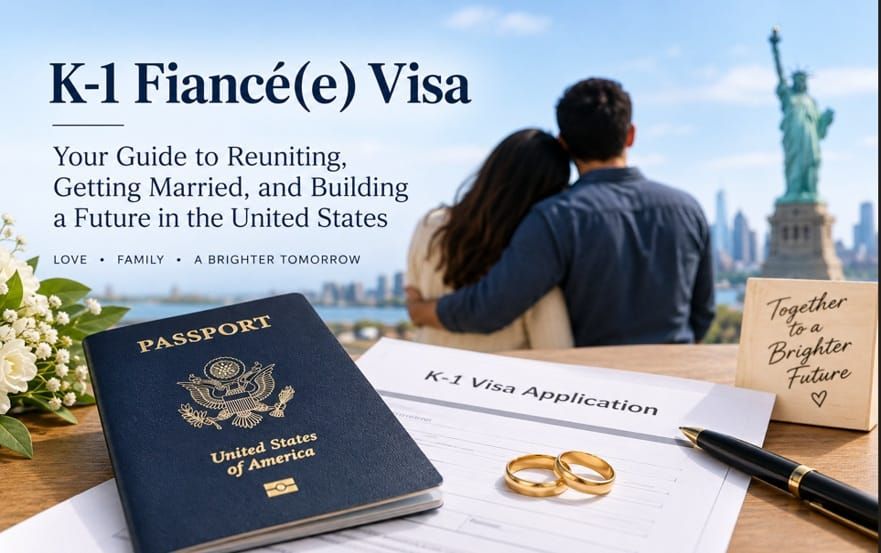
If you are engaged to a U.S. citizen and planning to get married in the United States, the K-1 fiancé visa may provide a pathway to enter the country for marriage. The K-1 visa is a nonimmigrant visa specifically designed for the foreign fiancé(e) of a U.S. citizen. After entering the United States, the K-1 visa holder must marry the U.S. citizen petitioner within 90 days.
Understanding the K-1 fiancé visa requirements and process before filing can help couples prepare the right documentation and avoid preventable delays.
What Is a K-1 Fiancé Visa?
A K-1 fiancé visa allows a foreign-citizen fiancé(e) of a U.S. citizen to travel to the United States for the purpose of marriage. The U.S. citizen fiancé(e) must first file Form I-129F, Petition for Alien Fiancé(e), with U.S. Citizenship and Immigration Services (USCIS).
Once the petition is approved, the case generally moves through the National Visa Center (NVC) and then to the U.S. embassy or consulate responsible for visa processing.
The K-1 visa is different from a CR-1 or IR-1 spouse visa because the couple is not yet married when the K-1 petition is filed.
K-1 Visa Requirements
Meeting the basic K-1 visa requirements is an important part of preparing a successful application. Generally, the following conditions apply:
- The petitioner must be a U.S. citizen.
- Both partners must be legally free to marry.
- The couple must generally have met in person at least once during the two years before filing the petition.
- Both parties must genuinely intend to marry.
- The marriage must be legally possible under the applicable law.
- The couple must intend to marry within 90 days after the foreign fiancé(e) enters the United States.
There are limited exceptions to the in-person meeting requirement, including certain situations involving extreme hardship or established cultural practices.
K-1 Fiancé Visa Process
The K-1 fiancé visa process begins when the U.S. citizen files Form I-129F with USCIS. USCIS reviews the petition and conducts required background checks.
After approval, the petition is forwarded to the NVC. The NVC assigns a case number and sends the case to the appropriate U.S. embassy or consulate.
The foreign fiancé(e) then completes the required visa application process, including Form DS-160, document preparation, medical examination and visa interview.
The applicant should normally be prepared to provide documents such as a valid passport, birth certificate, police certificates where required, evidence of previous marriages ending, photographs, medical examination records, financial-support documentation and evidence of the relationship. The consular officer may request additional evidence.
Evidence of a Genuine Relationship
One important part of a K-1 case is demonstrating that the relationship is genuine. Couples may provide appropriate evidence such as photographs together, travel records, correspondence, communication history, evidence of visits and other documentation showing the development of their relationship.
The evidence should be truthful and consistent with the information provided in the petition and visa application.
What Happens After K-1 Visa Approval?
After the K-1 visa is issued, the foreign fiancé(e) can travel to the United States. The couple must marry within 90 days of the K-1 holder's entry. After the marriage, the foreign spouse may generally apply for adjustment of status with USCIS to seek lawful permanent resident status.
Eligible children of a K-1 applicant may qualify for K-2 visas and have separate application requirements.
Conclusion
The K-1 fiancé visa can be an important immigration option for an engaged couple planning to marry in the United States. However, the process involves several stages, including the I-129F petition, USCIS processing, NVC processing, consular processing, medical examination and interview.
Careful preparation of the K-1 fiancé visa requirements and process, relationship evidence and supporting documents can help ensure that the application is complete and consistent. Because immigration rules and embassy procedures can change, applicants should verify current requirements with USCIS and the U.S. Department of State before filing.