Ireland Join Family Visa: How to Organize Sponsor Income, Relationship Evidence and Supporting Documents.

Planning to join a spouse, partner, parent, or other eligible family member in Ireland can be an exciting step. However, the application process often becomes stressful when applicants are unsure which documents to submit, how to demonstrate a genuine family relationship, or what financial evidence the sponsor must provide.
A well-prepared application is not simply about collecting as many documents as possible. It is about presenting the right evidence in a clear, consistent, and convincing way.
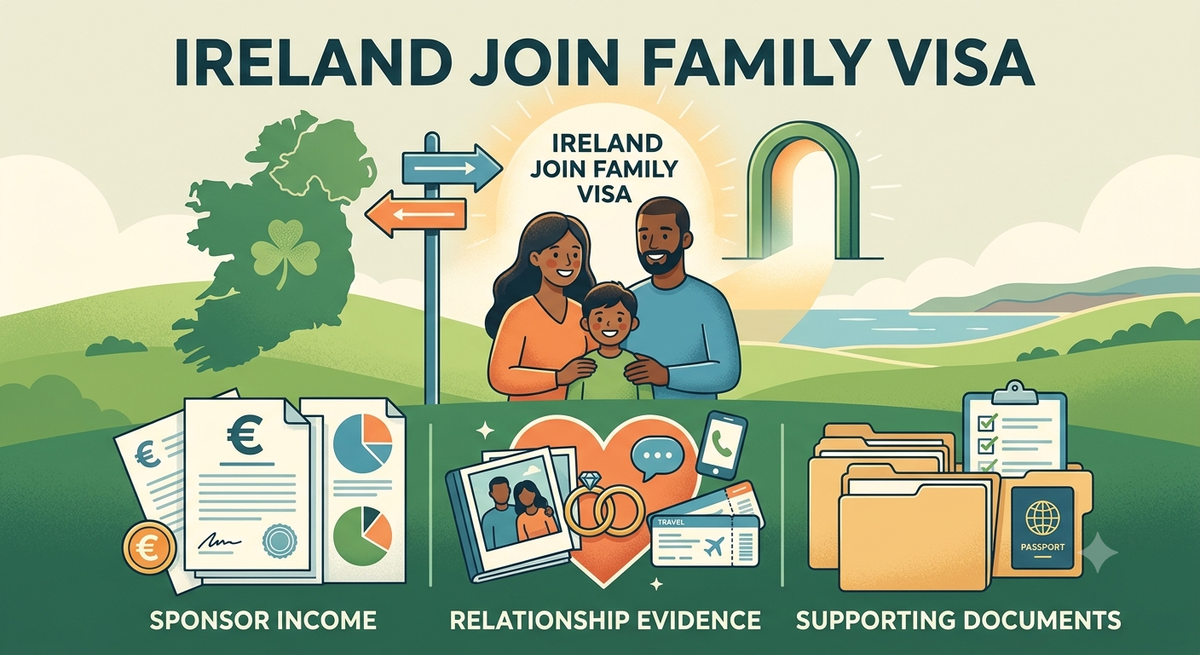
Understanding the Ireland Join Family Visa requirements before submitting an application can help families avoid unnecessary delays and reduce the risk of requests for additional information. Three areas deserve particular attention: the sponsor's financial circumstances, evidence of the family relationship, and the organization of supporting documents.
Understanding Ireland Join Family Visa Requirements
Ireland's family reunification rules depend on the applicant's relationship with the sponsor and the sponsor's immigration status. A sponsor may be an Irish citizen, an eligible non-EEA national living in Ireland, or another person whose permission allows family reunification under the applicable rules.
The requirements are not identical for every category. For example, the process for joining an Irish citizen spouse may differ from the process for joining a non-EEA worker who holds an Irish residence permission.
Before preparing the application, establish the following:
- The sponsor's nationality and current immigration permission in Ireland.
- The applicant's relationship to the sponsor.
- Whether the relevant family category is eligible for reunification.
- Whether the applicant needs a visa before travelling to Ireland.
- The applicable financial, documentary, and application procedures.
Applicants should consult the latest guidance from Immigration Service Delivery (ISD) and the Irish immigration authorities. Do not assume that a requirement applicable to one sponsor category automatically applies to another.
1. How to Organize Ireland Family Visa Sponsor Income Evidence
Financial evidence is an important part of many family reunification applications. Immigration authorities may need to establish whether the sponsor meets the financial conditions applicable to the particular category and whether the family is likely to require public support.
The Ireland family visa sponsor income requirements can vary according to the sponsor's status, the type of family relationship, and the rules in force when the application is made.
Rather than submitting a single salary slip, prepare a complete and consistent financial record.
Documents that may support the sponsor's financial position
Depending on the applicable rules and the sponsor's employment situation, useful documents may include:
- Recent payslips covering the relevant period.
- Employment confirmation from the employer.
- An employment contract stating the position, salary, and employment status.
- Bank statements showing salary credits.
- Revenue or tax documents, where applicable.
- Evidence of self-employment income, such as business accounts, tax returns, or relevant financial statements.
- Evidence explaining any recent change in employment or income.
Not every applicant will need every document listed above. Follow the checklist for the relevant sponsor category.
Make the financial evidence easy to verify
A common problem is that documents are submitted without a clear connection between them. For example, the employment letter may show one salary figure, while the bank statements show different amounts because of tax deductions, overtime, or variable working hours.
Explain these differences where necessary. If the sponsor recently changed jobs, include a short explanation and the relevant supporting evidence.
For self-employed sponsors, distinguish business turnover from personal income. A business account showing substantial deposits does not automatically establish the sponsor's personal earnings.
Most importantly, do not assume that a particular salary level guarantees approval. Confirm the applicable financial rules for the sponsor's category and provide genuine, verifiable evidence.
2. How to Prove Relationship Evidence for Ireland Family Visa
One of the most important questions applicants ask is how to prove relationship evidence for Ireland family visa applications.
The answer depends on the relationship being claimed. A marriage certificate may establish that a marriage was legally registered, but additional evidence can help demonstrate the history and reality of the relationship where required.
For spouses
Depending on the circumstances, supporting documents may include:
- A legally valid marriage certificate.
- Photographs from the relationship, wedding, and family occasions.
- Evidence of visits and time spent together.
- Travel tickets, passport stamps, or travel itineraries.
- Selected communication records showing an ongoing relationship.
- Evidence of shared residence, joint financial commitments, or household responsibilities, if available.
- Evidence of children together, where applicable.
A couple does not necessarily need to have every type of evidence listed above. Genuine relationships differ, particularly when spouses live in different countries because of employment or immigration restrictions.
For unmarried or de facto partners
Applicants in this category may need to provide stronger evidence of the nature and duration of their relationship, depending on the applicable rules.
Potential evidence includes proof of cohabitation, joint tenancy agreements, shared bills, correspondence addressed to the same home, travel records, and evidence of a continuing partnership.
If the couple has lived apart, explain why. Employment obligations, visa restrictions, family responsibilities, or other genuine circumstances may account for periods of separation. Support the explanation with available documents.
For children and other eligible family members
Birth certificates and civil registration documents may establish parent-child relationships. Depending on the circumstances, additional documents may be required to address custody, parental responsibility, dependency, or other eligibility conditions.
Do not assume that every relative qualifies under the same family reunification route. Eligibility must be established before relying on relationship evidence alone.
3. Keep the Relationship Timeline Consistent
A clear timeline can make a large application easier to understand.
For example, a spouse application might include the date the couple first met, the beginning of their relationship, the marriage date, periods of living together, visits during periods of separation, and the planned move to Ireland.
Check that the dates are consistent across application forms, personal statements, travel records, and civil documents.
If a genuine discrepancy exists, explain it rather than ignoring it. A difference in a date or address may have an innocent explanation, but unexplained inconsistencies can create avoidable questions.
Avoid submitting hundreds of screenshots without context. Select representative evidence from different periods and label it with dates and brief descriptions. The goal is to show a coherent history, not simply a large volume of material.
4. Organize Supporting Documents Before Submission
Even strong evidence can become difficult to assess when it is poorly arranged. A practical document structure helps applicants, sponsors, and advisers check whether anything important is missing.
Consider organizing the application into these sections:
Section A: Applicant documents
- Passport and relevant identity documents.
- Visa application summary and required forms.
- Previous immigration information, where relevant.
- Civil status documents and required photographs.
Section B: Sponsor documents
- Passport or identity documents.
- Evidence of Irish citizenship or current immigration permission.
- Proof of residence in Ireland, where required.
- Employment and financial evidence, as applicable.
Section C: Relationship evidence
- Marriage or birth certificates, where relevant.
- Relationship timeline or supporting statement.
- Selected photographs, travel records, and communication evidence.
- Cohabitation or dependency documents, where applicable.
Section D: Additional supporting documents
- Explanations for periods of separation or unusual circumstances.
- Certified translations of documents not in English or Irish, where required.
- Other documents specifically requested by the relevant immigration authority.
This is a general organizational framework, not a universal checklist. The official instructions for the relevant category determine which documents are mandatory.
5. Common Mistakes That Can Weaken an Application
Families can spend considerable time collecting documents and still overlook important details. Common problems include submitting incomplete financial records, providing inconsistent relationship dates, overlooking required translations, or failing to explain unusual circumstances.
Other mistakes include relying on a marriage certificate alone when further relationship evidence is required, assuming that every sponsor can bring the same family members, or using outdated application instructions.
Never create or alter evidence to make an application appear stronger. False documents or misleading statements can have serious immigration consequences.
Before submission, review every document for accuracy, legibility, consistency, and compliance with the current requirements.
6. A Final Review Before Applying
Before sending the application, ask three questions:
- Eligibility: Does the sponsor's status permit this type of family reunification, and does the applicant qualify under the relevant rules?
- Financial evidence: Have the applicable sponsor income conditions been checked, and do the supporting records accurately explain the sponsor's circumstances?
- Relationship evidence: Do the civil documents and additional evidence establish the claimed relationship and address any unusual circumstances?
If the application involves previous refusals, complicated immigration histories, long periods of separation, dependency issues, or uncertain financial eligibility, obtaining appropriate professional advice before submission may be worthwhile.
Conclusion
A successful family reunification application begins with careful preparation. Understanding the Ireland Join Family Visa requirements, organizing the sponsor's income evidence, and presenting a clear relationship history can help make the application easier to assess.
Every family has a different story. Some couples have lived together for years, while others have maintained a genuine relationship across borders. The important thing is to provide accurate documents that reflect the actual circumstances and satisfy the requirements for the relevant immigration category.
With a well-organized file and a careful final review, applicants can approach the process with greater clarity and confidence. Always check the latest official Irish immigration guidance before submitting an application, as eligibility rules and documentary requirements may change.
Disclaimer: This article provides general information, not legal advice or a guarantee of visa approval. Requirements depend on the applicant's circumstances and the sponsor's immigration status.