EB-5 Visa Requirements 2026: Investment Amount, Job Creation & Eligibility.

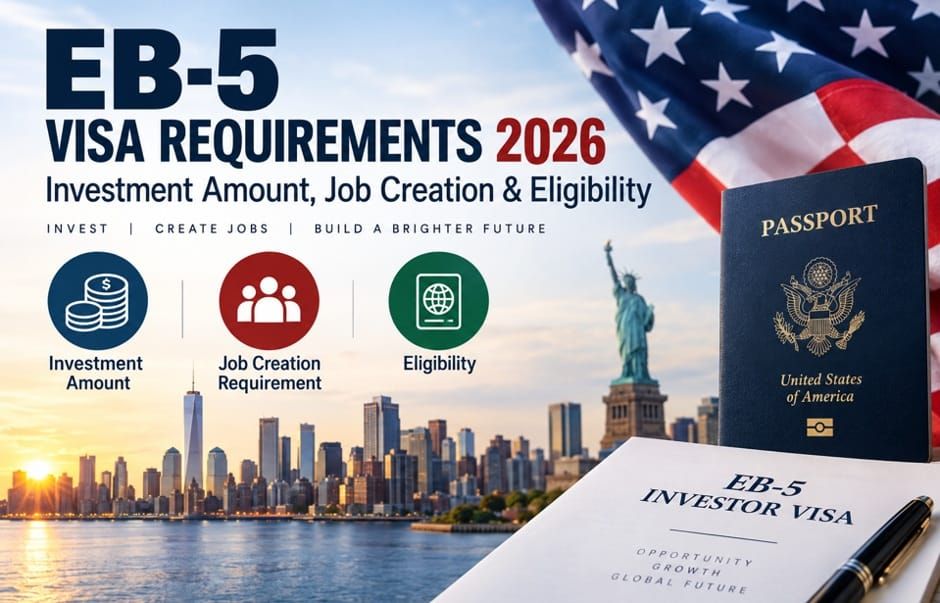
The EB-5 Immigrant Investor Program provides a pathway for qualifying foreign investors and their eligible family members to obtain U.S. permanent residence through investment in a qualifying U.S. commercial enterprise. Understanding the EB-5 visa requirements 2026 is important before committing investment capital or selecting an EB-5 project.
The program involves several key requirements, including the required investment amount, lawful source of funds, job creation, qualifying business activity, and compliance with applicable immigration requirements.
What Is the EB-5 Visa?
The EB-5 program is an employment-based immigrant visa category for investors who invest qualifying capital in a new commercial enterprise in the United States and satisfy the applicable job-creation requirements.
Depending on the investment structure, an investor may participate through a Regional Center project or pursue a qualifying direct investment. Investors should carefully evaluate the project, documentation, financial structure, and immigration requirements before making an investment.
EB-5 Minimum Investment
One of the most important considerations is the EB-5 minimum investment.
Under the current EB-5 framework, the required investment is generally $800,000 for qualifying investments in a targeted employment area (TEA) and $1.05 million for investments outside a TEA, subject to applicable statutory and regulatory adjustments.
A TEA can generally include a qualifying rural area or an area meeting the applicable high-unemployment requirements. Certain infrastructure projects may also qualify for the reserved EB-5 visa category.
Because investment thresholds and program rules can change through statutory or regulatory mechanisms, investors should verify the applicable amount and requirements at the time of filing.
EB-5 Job Creation Requirement
The EB-5 job creation requirement is a central element of the program. Generally, the investment must result in the creation of at least 10 full-time jobs for qualifying U.S. workers.
For Regional Center investments, qualifying indirect and induced employment may be counted under applicable USCIS requirements and economic methodologies. Direct investment cases generally require the qualifying jobs to be created by the new commercial enterprise itself.
Investors should review how a particular project intends to create and document the required employment before investing.
Lawful Source and Path of Funds
Meeting the investment amount alone is not sufficient. EB-5 investors must generally demonstrate that the invested capital was obtained through lawful sources and that the movement of funds can be documented.
Depending on the investor's circumstances, evidence may include tax records, bank statements, business records, property-sale documents, loan documents, inheritance records, or other financial documentation.
A well-organized source-and-path-of-funds record can help establish the lawful origin and transfer of the investment capital.
EB-5 Green Card Requirements
Understanding the EB-5 green card requirements is equally important. An approved EB-5 petition does not simply mean that the investor immediately receives an unconditional green card.
Eligible investors may initially receive conditional permanent residence when the applicable visa and immigration requirements are satisfied. During the relevant conditional-residence period, the investor must continue meeting the program requirements, including the applicable job-creation requirements.
The investor subsequently files the required petition to remove the conditions on permanent residence and must provide evidence demonstrating compliance with the EB-5 requirements.
Who Can Apply for an EB-5 Visa?
An investor generally needs to:
- Invest the required amount of qualifying capital.
- Invest in a qualifying new commercial enterprise.
- Demonstrate that the investment capital was lawfully obtained.
- Satisfy the applicable job-creation requirement.
- Provide appropriate documentation supporting the investment and source of funds.
- Meet applicable immigration and admissibility requirements.
The investor's spouse and qualifying unmarried children under the applicable age requirements may also be eligible for derivative permanent residence.
Conclusion
The EB-5 visa requirements 2026 involve considerably more than simply investing money in a U.S. business. Investors need to consider the investment threshold, project structure, TEA qualification, source and path of funds, job creation, immigration eligibility, and documentation requirements.
Before making a substantial investment, prospective investors should conduct appropriate financial and immigration due diligence and obtain advice from qualified U.S. immigration and financial professionals. A carefully prepared EB-5 strategy can help investors understand the requirements and organize the evidence needed for the immigration process.